
What is Gender? Part 3
The last installment of my talk from the Brooklyn Public Library "Sips and Scholars" Series

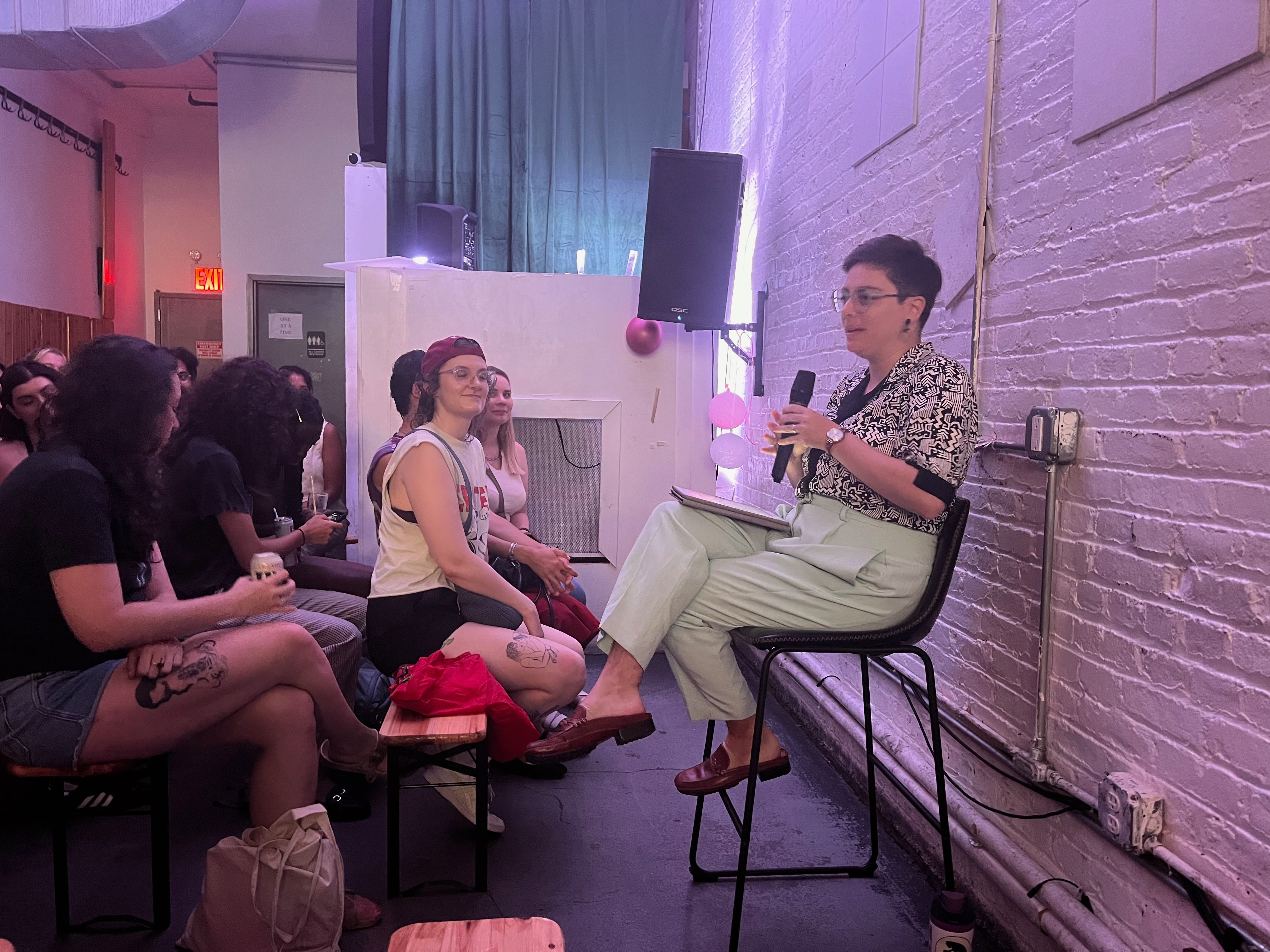
This July, I was lucky enough to be invited to give a lecture at The Bush through a partnership between the Brooklyn Public Library and the Brooklyn Institute for Social Research, where I’m a member of the associate faculty. The lecture was part of BPL’s Sips and Scholars series, which features BISR faculty giving public seminars at bars and venues across Brooklyn. I love these kinds of events, ones that introduce people to local resources like public libraries and provide access to rigorous thought-provoking conversations on important topics, without the traditional gatekeeping of higher education.
Without further ado, here is a lightly edited version of the third and final installment of my talk “What is Gender?” You can check out Part 1 of my talk here and part 2 of my talk here.
Judith Butler’s argument that gender, as something one does (rather than something one is), might be transformed through subversive repetition goes a long way toward destabilizing the gender binary. And yet, Butler largely elides the question of trans embodiments and gender-affirming healthcare in Gender Trouble. The word “transsexuality” only appears once in the book, according to the index, and the word “transgender” does not appear in the book’s main text at all.
Around the same time that Butler was writing and publicizing Gender Trouble, the tides were beginning to turn in the realm of queer and trans politics. Trans activists had been participants in various American social movements throughout the twentieth century, and trans people were fundamental players in the queer uprisings of the 1960s, including the uprisings at Compton’s Cafeteria in San Francisco, Dewey’s Cafeteria in Philadelphia, and the Stonewall Inn in New York City.1
Of course, it’s important to note that the umbrella term “trans” did not exist at the time and is a category we can only apply in retrospect. The activists of the 1960s variously identified as drag queens, transvestites, transsexuals, butches, and cross-dressers, along with a whole host of other terms that have fallen out of favor in the intervening years.
The term “transgender” did not emerge in its current usage until the 1990s. As Susan Stryker explains in her introduction to The Transgender Studies Reader, the term was first coined in the 1980s and is often attributed to Virginia Prince, who used it to refer to individuals “like herself whose personal identities she considered to fall somewhere between” transvestite and transsexual, popular terms for trans embodiment that had been coined in the 1910s and the 1950s, respectively. The distinction between the two terms largely rested on medical intervention; a transvestite being someone who “episodically” dressed in gender-affirming clothes, and a transsexual being someone who sought gender-affirming surgeries to live fully in their gender. For Prince, transgender offered a middle ground, applying to those who socially transitioned, but did not seek medical transition.2
This particular usage of transgender was soon eclipsed by the appearance of the word in Leslie Feinberg’s 1992 pamphlet Transgender Liberation: a Movement Whose Time has Come. Unlike Prince, who used transgender to describe a narrow category of trans identity, Feinberg opened up the term’s usage to include “all individuals who were marginalized or oppressed due to their difference from social norms of gendered embodiment.” For Feinberg, transgender was a kind of umbrella term that might encompass a wide range of identities, from transsexual to butch to sissies to tomboys.
The idea behind Feinberg’s rearticulation of the term was not to create a new, more precise identity that pertained to a small subset of people, but rather to expand the kinds of alliances that might be forged between oppressed minorities, with Feinberg’s ultimate goal being solidarity across genders in the struggle for “social, political, and economic justice.”

A few years earlier, Sandy Stone’s famous essay “The Empire Strikes Back: A Posttransexual Manifesto” had used different vocabulary to achieve a similar aim, setting the scene for Feinberg’s intervention. Though Stone did not use the term transgender in her essay, she did radicalize the notion of transsexual identity and expanded it beyond its early usage. She also reclaimed the word transsexual from trans-exclusionary radical feminists, who had targeted Stone in transphobic screeds like Janice Raymond’s 1979 book The Transsexual Empire.3 In her essay, Stone encouraged transsexuals to challenge notions of authenticity when it came to gender by “abandoning the practice of passing as nontranssexual.”
Transsexuals, in other words, need not prop up the system of gender that constrained them by trying to go “stealth” as “true women” or “true men,” according to Stone. Instead, they could reveal “true” gender to be as much of a lie for non-transsexual people as it was for transsexual people, an idea that trans theorists would continue to build upon in the ensuing years.
One of those trans theorists was Susan Stryker, a young academic with a newly minted PhD in US history from the University of California, Berkeley. Stryker entered academia at a time when gay and lesbian studies and women’s studies were both established, if still relatively new, fields. Transgender studies as a discipline, however, did not yet exist.
Stryker made a splash with her first published article, “My Words to Victor Frankenstein Above the Village of Chamounix: Performing Transgender Rage” in 1994. The article had originally been given as a presentation, or maybe it’s better to call it a performance, at an academic conference on the topic of “rage across the disciplines.” Stryker showed up at California State University that June in what she described as:
“genderfuck drag—combat boots, threadbare Levi 501s over a black lace body suit, a shredded Transgender Nation T-shirt with the neck and sleeves cut out, a pink triangle quartz crystal pendant, grunge metal jewelry, and a six-inch long marlin hook dangling around my neck on a length of heavy stainless steel chain.” Stryker’s leather jacket had “handcuffs on the left shoulder, rainbow freedom rings on the right side lacings, and Queer Nation-style stickers reading SEX CHANGE, DYKE, and FUCK YOUR TRANSPHOBIA plastered on the back.”
Stryker’s style of dress as well as her style of performance were a notable departure from the norms of gay and lesbian academic spaces. Unlike Butler, whose target of critique was largely straight feminists and male theorists of gender, Stryker took aim at her gay and lesbian peers. Indeed, it was a small subset of so-called “radical” lesbians who created a theoretical framework for trans-exclusionary radical feminism in the 1980s. Janice Raymond and Mary Daly were among them, deriding trans women as inauthentic intruders into the sacred realm of femininity, and as threats to the feminist cause.4
Stryker, herself a lesbian, described a troubling consensus among gay and lesbian activists:
“The attribution of monstrosity remains a palpable characteristic of most lesbian and gay representations of transsexuality, displaying in unnerving detail the anxious, fearful underside of the current cultural fascination with transgenderism. Because transsexuality more than any other transgender practice or identity represents the prospect of destabilizing the foundational presupposition of fixed genders upon which a politics of personal identity depends, people who have invested their aspirations for social justice in identitarian movements say things about us out of sheer panic that, if said of other minorities, would see print only in the most hate-riddled, white superemacist, Christian fascist rags.”
She then goes on to quote a letter to the editor from a popular gay/lesbian periodical in which the writer proudly proclaimed that they considered transsexualism to be a fraud, and participants in it, “perverted.”
This overt transphobia within gay and lesbian communities was not just a problem of words, Stryker explained, but a matter of life and death. In her essay, she tells the story of Filisa Vistima, a trans woman living in Seattle who described herself in one of her journals as “Frankenstein’s monster” only two months before committing suicide. Stryker places the responsibility for Vistima’s suicide squarely on the shoulders of the Seattle queer community, some members of which overtly “opposed Vistima’s participation” in lesbian and bisexual organizations “because of her transsexuality.” After her death, the same community that had rejected her blamed her for not seeking help. “In this case,” Stryker tells us, “not only did angry villagers hound their monster to the edge of town, they reproached her for being vulnerable to the torches.”
Stryker makes explicit what only ever remains implicit in the pages of The Second Sex and Gender Trouble: that gender—as situation, as social construction, as performance—is not just a problem for those most oppressed by it: women, lesbians, gay men, trans people. “You are as constructed as me,” Stryker proclaims to her non-transsexual listeners/readers, “the same anarchic womb has birthed us both. I call upon you to investigate your nature as I have been compelled to confront mine.”
Throughout her essay, Stryker compares herself to Frankenstein’s monster, probing the meaning of transgender rage. In Mary Shelley’s novel, Dr. Frankenstein expects the monster he creates to be a source of rapture for him, proof that he has unlocked almost “unlimited” powers over nature and unfolded the “deepest mystery of creation.” Instead, the monster is a source of dread for the doctor. The monster escapes Frankenstein’s grasp, and it is immediately obvious that he has a mind of his own. After its escape, Stryker tells us, the monster “learns something of its situation in the world, and rather than bless its creator, the monster curses him.”
She goes on to explain: “My own experience as a transsexual parallels the monster’s in this regard. The consciousness shaped by the transsexual body is no more the creation of the science that refigures its flesh than the monster’s mind is the creation of Frankenstein. The agenda that produced hormonal and surgical sex reassignment techniques is no less pretentious, and no more noble, than Frankenstein’s.”
This agenda does not “guarantee the compliance of subjects thus embodied with the agenda that resulted in a transsexual means of embodiment…”
“As we rise up from the operating tables of our rebirth, we transsexuals are something more, and something other, than the creatures our makers intended us to be. Though medical techniques for sex reassignment are capable of crafting bodies that satisfy the visual and morphological criteria that generate naturalness as their effect, engaging with those very techniques produces a subjective experience that belies the naturalistic effect biomedical technology can achieve.”
Here, we might think back to Butler’s idea that gender is performative; that gender exists in the doing. If gender is not a noun, if it does not refer back to some an original, immutable “sex,” then both sex and gender are processes of becoming, whether that process is made conscious by a given individual or not. Stryker’s transsexual “monster” takes ownership of this process, doing gender through the means available to them, whether social or medical. Rather than simply mimicking or reproducing idealized binary gender, the trans subject reappropriates it. In the process of this reappropriation, gender itself is changed. Sex is revealed to be an unreliable truth; just as much of a construction as the “gender identity” trans people are so often accused of falsely claiming.
So, if there is no essential, immutable truth of sex, and if gender is not simply the social construction of sex, what are we to do with this analysis? What does it mean, concretely, for sex and gender to be mutable and contingent?
Queer theory does not pertain only to queers. Rather than embracing a minoritizing view of queer identity, one that unwittingly upholds compulsory heterosexuality by claiming that queerness is only an exception to the rule, we might consider other possible grounds for queer activism that welcome and encourage coalitions.
When it comes to the question of political organizing among queer communities in the United States, one of the most impactful voices to challenge identity-based queer organizing was Cathy Cohen, who in 1997 published her seminal essay “Punks, Bulldaggers, and Welfare Queens: The Radical Potential of Queer Politics?”
Like Stryker, Cohen’s essay takes aim at the corrosive effects of identity policing and political myopia within gay and lesbian movements. Drawing on the work of Kimberlé Crenshaw, Patricia Hill Collins, and the Combahee River Collective, Cohen employs an intersectional analysis of queer politics to challenge the orthodoxy that “queer” is always already more radical than its opposite.
For Cohen, as for theorists like Butler and Stryker, there are concrete political stakes to her analysis of queerness. Her exploration of queer identity is not a purely deconstructionist project. Cohen explains: “Many of us continue to search for a new political direction and agenda, one that does not focus on integration into dominant structures but instead seeks to transform the basic fabric and hierarchies that allow systems of oppression to persist and operate effectively.”
Queer politics, as a practical corollary to queer theory, hit the political scene in the 1990s with an in-your-face style of direct organizing that emphasized queer people’s essential difference from their straight counterparts. Instead of enacting assimilation into mainstream heterosexual culture, activist groups like Queer Nation dramatized a queer vs. straight dichotomy. “Whether in the famous ‘I Hate Straights’ publication,” Cohen tells us, “or queer kiss-ins at malls and straight dance clubs, very near the surface of queer political action is an uncomplicated understanding of power as it is encoded in sexual categories: all heterosexuals are represented as dominant and controlling and all queers are understood as marginalized and individual.”
Based on her observations of queer activism at the height of queer theory, from roughly 1990-1997, Cohen concludes that “a truly radical or transformative politics has not resulted from queer activism. In many instances, instead of destabilizing the assumed categories and binaries of sexual identity, queer politics has served to reinforce simple dichotomies between heterosexual and everything ‘queer’.”
Cohen is not interested in rejecting the fruits of queer theory wholesale. Indeed, she points out that queer theory not only expresses the constructed nature of sexuality and sexual categories, but also “the varying degrees and multiple sites of power distributed within all categories of sexuality, including the normative category of heterosexuality.” By making the exploration of gender and sexuality a question of power, queer theorists opened up the terrain for new kinds of political organizing that challenged and reimagined gendered power, rather than simply reproducing it.
At the same time, queer politics increasingly fell into a trap of homogenized identity. Queer came to encompass many fluid genders and sexual orientations. As a political identity, however, queer became a blunt instrument used by some activists to disavow or simply ignore intersectionality.
From an intersectional perspective, Cohen argues: “queer activists who evoke a single-oppression framework misrepresent the distribution of power within and outside of gay, lesbian, bisexual, and transgendered communities, and therefore limit the comprehensive and transformational character of queer politics.”
There is no room, in this kind of single-issue queer activism, for accountability within queer communities when it comes to intra-community oppressions like racism, classism, and ableism. Additionally, this dichotomous politics of “queer versus straight” erases the intersecting oppressions that operate among straight people along axes of gender, race, class, nationality, and ability. This erasure weakens queer social movements and disincentivizes coalitional work.
Instead of a politics that continually polices identity, Cohen envisions:
“a politics where one's relation to power, and not some homogenized identity, is privileged in determining one's political comrades. I'm talking about a politics where the nonnormative and marginal position of punks, bulldaggers, and welfare queens, for example, is the basis for progressive transformative coalition work. Thus, if there is any truly radical potential to be found in the idea of queerness and the practice of queer politics, it would seem to be located in its ability to create a space in opposition to dominant norms, a space where transformational political work can begin.”
At this juncture, as I near the end of my talk, I want to return to some of the questions that I outlined in my introduction. Indeed, in light of recent political developments, we might find ourselves less receptive to deconstructive theories of gender like Judith Butler’s, which have been coopted and misused by far-right politicians to claim that transgender identity is too amorphous to warrant constitutional protections.
We might think back to the words of Justice Amy Coney Barrett on the topic of transgender identity in the United States vs. Skrmetti, which I quoted at the beginning of this talk: “The boundaries of the group,” Barrett argues, “are not defined by an easily ascertainable characteristic that is fixed and consistent across the group.” This sentence might just as easily have been written by Judith Butler in 1990 to describe the fluidity of the category “woman.”
What are we to make of this striking resemblance?
First of all, we would do well to consider how far “state protections” can actually take us. There is no question that transgender people are and should be legally considered a “discrete group” for the purpose of American jurisprudence, and that they should be legally protected from discrimination under the Equal Protection Clause of the Fourteenth Amendment. There is no question that transgender minors and adults should have unrestricted access to gender-affirming healthcare in every state as well as on the federal level, as well as unrestricted access to gender-affirming bathrooms, sports teams, and educational resources at every age.
But how much can a carceral white supremacist oligarchy really do to protect transgender people? These protections alone, even if they are enacted, would not keep a young Black trans woman from arrest and abuse at the hands of police, or a trans sex worker from incarceration, or a working-class trans man from being evicted by a predatory landlord. This is not to say that these legal protections for transgender people are not worth fighting for. They are. But we also should not limit our political perspective by merely accepting the neoliberal structures of rights-based inclusion that currently exist.
It is for this reason that I find myself returning, in this particular political moment, to the concept of “livability,” a term that Judith Butler has used to describe their political engagements across boundaries of identity, including their activism on behalf of Palestinian liberation and their activism against trans-exclusionary radical feminism.5
Gender is far more than just an identity that can be affirmed or rejected. Gender is one oppressive regulatory system among many that determines which subjects get to lead livable lives. Unlivability becomes a consequence of gender non-normativity, baked into the social distribution of power. Certainly, the current administration is hell-bent on making trans people’s lives unlivable, just as it hell-bent is on making the lives of immigrants, poor women of color, Palestinians, and pregnant people unlivable.
How do we—feminists, queer people, socialists, gender traitors—reject this dehumanization with everything we’ve got?6 How do we fight for livable lives in ways that do not consign others to unlivability?
I don’t have answers to these questions, but I do hope that my talk has given you some new ways of answering these questions for yourself.
If you take one thing away from this lecture, I hope you take away a sense of curiosity about the terms of debate that most people take for granted in our current political moment. When you hear the word “gender,” I hope it inspires more questions than it does answers. Thank you.
For more on this, see Susan Stryker’s excellent book Transgender History: The Roots of Today’s Revolution. Second edition. Seal Press, 2017.
Stryker, Susan. “(De)Subjugated Knowledges: An Introduction to Transgender Studies.” In The Transgender Studies Reader. Routledge, 2006.
See Sandy Stone’s oral history interview for Outwords, https://theoutwordsarchive.org/interview/sandy-stone/
For more on TERFs, see Sophie Lewis’s Enemy Feminisms. https://www.haymarketbooks.org/books/2440-enemy-feminisms
See Butler’s books Precarious Life and What World is This?
The phrasing of this question is inspired by Bassichis, Morgan, Alexander Lee, and Dean Spade. “Building an Abolitionist Trans and Queer Movement with Everything We’ve Got.” In The Transgender Studies Reader 2. Taylor & Francis, 2014.